

The MinXSS-2 Mission – Overview
September 9, 2018
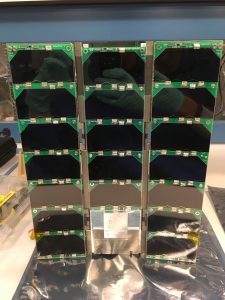 The MinXSS-2 mission, scheduled to launch in 2018 November, improves several aspects of MinXSS-1.
- The primary science instrument, an Amptek X123 silicon drift detector, has been upgraded with higher energy resolution and greater dynamic range. That means we’ll be able to resolve spectral lines better and we’ll be able to observe larger solar flares without saturating the detector.
- We’ve enabled an option in the flight radio to transmit at 19200 bps in addition to the default 9600 bps. This will allow us to downlink more data than we could on MinXSS-1.
- We’ve also built an additional ground station in Fairbanks, Alaska, which will allow yet more data to be downlinked.
- MinXSS-2 can store commands onboard that will be executed at particular times. We can use this to downlink over any other ground station that we have coordinated with. Upshot: more data downlinked.
- MinXSS-2 is going into a sun-synchronous orbit. This high latitude orbit also means we’ll be very well aligned with our ground station in Alaska and will get more long duration passes each day there. Again, more data (we really want more science data, if you couldn’t tell).
- The orbit of MinXSS-2 will also be at higher altitude: 575 km instead of the 400 km that MinXSS-1 started with. That means that there will be less drag and so the satellite can stay up longer. We’re expecting to operate MinXSS-2 for about 5 years, compared with just 1 for MinXSS-1. Guess what that means? More data.
With all the new data we’re expecting from MinXSS-2, it also made sense to expand the science objectives and add some more co-investigators to address them. The full list of Co-Is is at the bottom of this post. With a 5-year mission, we can observe a significant chunk of the 11-year solar cycle. Our science questions really focus on that:
- How do soft X-ray (SXR) flare energetics change with different size active regions / magnetic complexity over the solar cycle?
- What are the differences in Earth’s ionosphere and thermosphere responses to the solar SXR radiation during different solar cycle phases?
- Do the coronal heating processes, plasma temperature, and composition change for active regions during the different solar cycle phases?
Keep an eye out for papers addressing these questions using brand new MinXSS data in the coming years!
The list of investigators on MinXSS-2 is:
- Dr. Thomas N. Woods (principal investigator; CU/LASP)
- Dr. Amir Caspi (Southwest Research Institute)
- Dr. Phillip Chamberlin (CU/LASP)
- Dr. Andrew Jones (CU/LASP)
- Mr. Rick Kohnert (CU/LASP)
- Dr. James Paul Mason (NASA Goddard Space Flight Center)
- Dr. Christopher S. Moore (Harvard Smithsonian Center for Astrophysics)
- Dr. Scott Palo (CU Aerospace Engineering Sciences)
- Dr. Stanley Solomon (High Altitude Observatory / National Center for Atmospheric Research)
- Dr. Harry Warren (Naval Research Laboratory)

