The Sun Approaches Its 11 Year Minimum and Activity Cycle 24
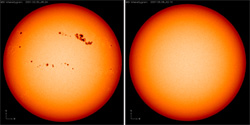
Figure 1: Near the peak of the solar activity cycle many sunspots appear regularly on the Sun, as seen in the left image on 30 March 2001 in Cycle 23. Currently, solar activity is near the minimum of the 11-year cycle and sunspots may be absent entirely, as seen on 8 May 2007, in the right image.
Observations reveal that magnetic activity on the Sun varies dramatically over time, with a near periodic 11-year cycle. Large dark sunspots are frequently observed on the Sun during solar maximum and few, if any, sunspots are seen during solar minimum. Figure 1 compares images of the Sun’s visible disk during high (left) and low (right) solar activity. Sunspot occurrence is an indicator of a change in the Sun’s energy output. In addition to the sunspots, large bright prominences called faculae—faculae is a Latin word that means small torches—are more commonly observed during solar maximum. The occurrence of sunspots and faculae changes the total energy output from the Sun—total solar irradiance. (Read more…)
«Return to the Meetings/News page