SORCE REU Students
By Marty Snow, LASP, Univ. of Colorado
Each summer, the SORCE program at LASP employs three student research interns as part of the Boulder Solar Alliance’s Research Experience for Undergraduates (REU) program. This year’s students – Lauren Bearden, Jess Haskins, and Ariana Giorgi – are working on a diverse set of projects using SORCE data. The students come to Boulder for 8 weeks of research, starting with a series of lectures on Solar and Space Physics from experts in the field, and ending with a student symposium where the REU students present their findings. Further information about the program can be found at http://lasp.colorado.edu/reu.
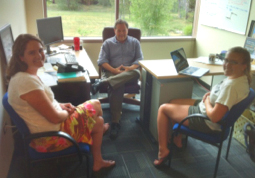
Jess Haskins with her mentors, Aimee Merkel (left) and Jerry Harder (center).
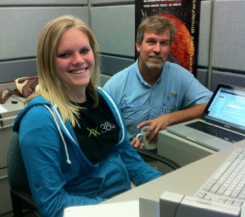
Lauren Bearden (left) is working with Odele Coddington, Erik Richard (right), and Marty Snow
Lauren Bearden from Colgate University is studying the solar spectral irradiance variations in the visible and infra-red using SIM data. In particular, she is studying how the rotational variability evolves over the course of the solar cycle. Odele Coddington, Erik Richard, and Marty Snow are helping to guide her investigation.
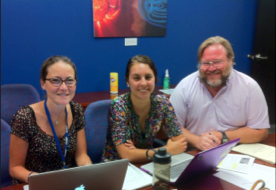
Aurélie Reberac from CNRS, France (left), REU Student Ariana Giorgi from Lafayette College (center) and Marty Snow (right) are discussing SOLSTICE and SPICAM stellar occultation data.
Ariana Giorgi (Lafayette College) is studying some of the stellar occultation observations from SOLSTICE. The measurements at 250 nm can be used to measure ozone density in the upper atmosphere. Ariana is concentrating on a subset of the observations that show an unexpected emission at an altitude of 150 km. She had the good fortune to consult with one of our collaborators from France about similar occultation observations on Mars from the SPICAM instrument.
«Return to the Meetings/News page