About
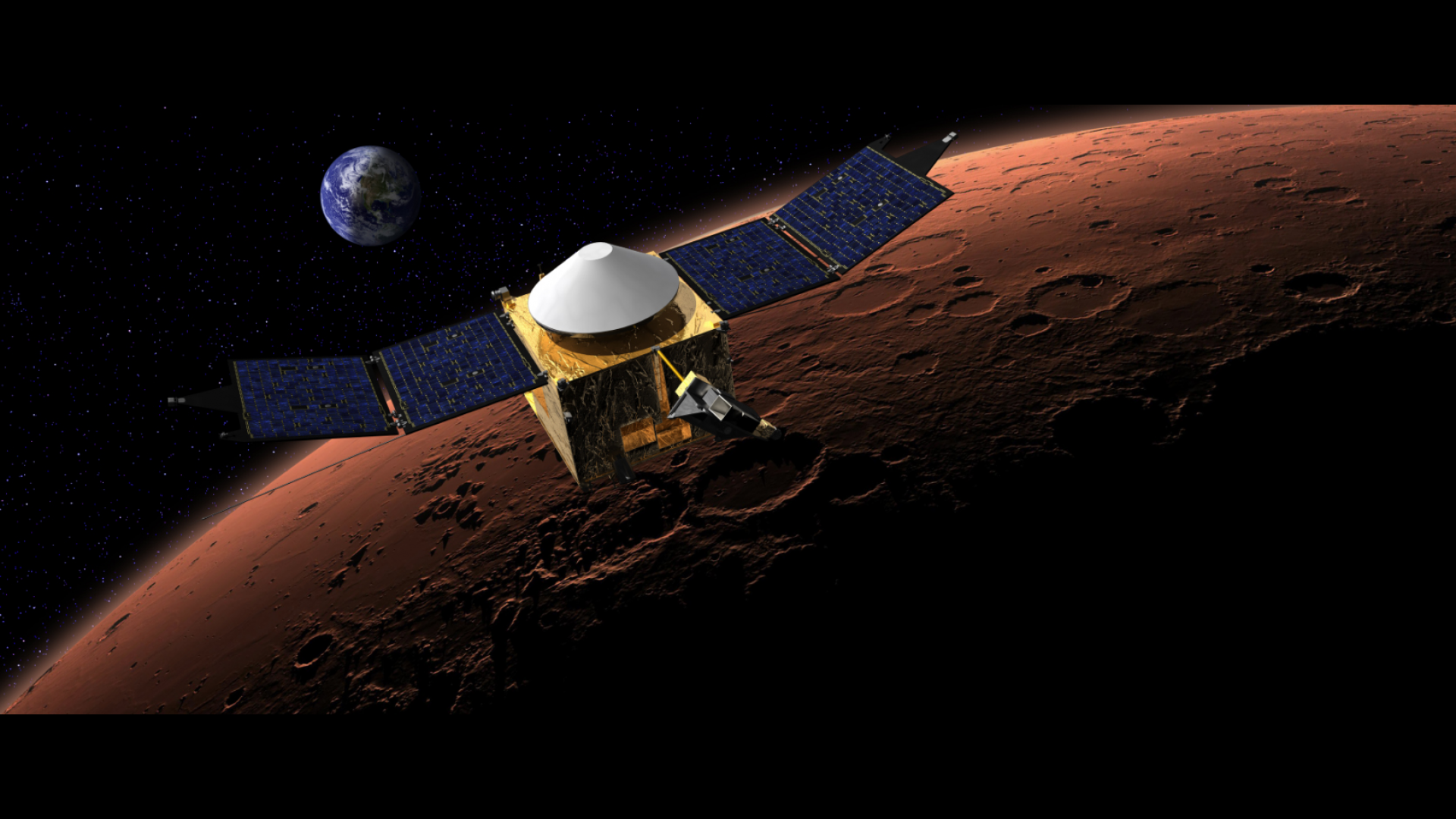
The Mars Atmosphere and Volatile EvolutioN (MAVEN) mission, scheduled for launch in late 2013, will be the first mission devoted to understanding the Martian upper atmosphere.The goal of MAVEN is to determine the role that loss of atmospheric gas to space played in changing the Martian climate through time. Where did the atmosphere—and the water—go?
MAVEN will determine how much of the Martian atmosphere has been lost over time by measuring the current rate of escape to space and gathering enough information about the relevant processes to allow extrapolation backward in time.

Planetary scientist Bruce Jakosky is the principal investigator for the MAVEN mission. (Courtesy Casey A. Cass, University of Colorado)
MAVEN Principal Investigator:
Dr. Bruce M. Jakosky
Professor of Geological Sciences.
Faculty Research Associate, Laboratory for Atmospheric and Space Physics
Director, Center for Astrobiology
Ph.D., 1982, California Institute of Technology
Research Interests:
Prof. Jakosky teaches undergraduate and graduate courses in both Earth and planetary geology and extraterrestrial life, including both the science and the societal and philosophical issues relating to the science. His research interests are in the geology of planetary surfaces, the evolution of the Martian atmosphere and climate, the potential for life on Mars and elsewhere, and the philosophical and societal issues in astrobiology. He has been involved with the Viking, Solar Mesosphere Explorer, Clementine, Mars Observer, Mars Global Surveyor, Mars Odyssey, and Mars Science laboratory spacecraft missions, and is involved in planning future spacecraft missions. He heads up the University of Colorado’s team in the NASA Astrobiology Institute. He has published more than 100 papers in the refereed scientific literature. His book “The Search for Life on Other Planets” was published in 1998 by the Cambridge University Press, and “Science, Society and the Search for Life in the Universe” was published in 2006 by University of Arizona Press. He serves on numerous national advisory committees. He serves as Associate Director for Science in the Laboratory for Atmospheric and Space Physics at the University of Colorado.