About MOP
Who are we?
The CU MOP group studies magnetospheric phenomena of the outer solar system for the Laboratory for Atmospheric and Space Physics (LASP) at the University of Colorado Boulder. For a list of conferences of the international MOP community see the MOP Conference link above.
Through computer modeling and data analysis of satellite missions, the MOP group seeks to better understand the electromagnetic processes that dominate space surrounding the outer planets. Electromagnetic processes that occur in these regions cause phenomena such as aurora, emission of energetic particles, and inflation/distortion of magnetic fields. Data that the group analyzes comes from robotic missions that have visited the outer solar system (Pioneer, Voyager, Galileo, and Cassini).
What is a Magnetosphere?
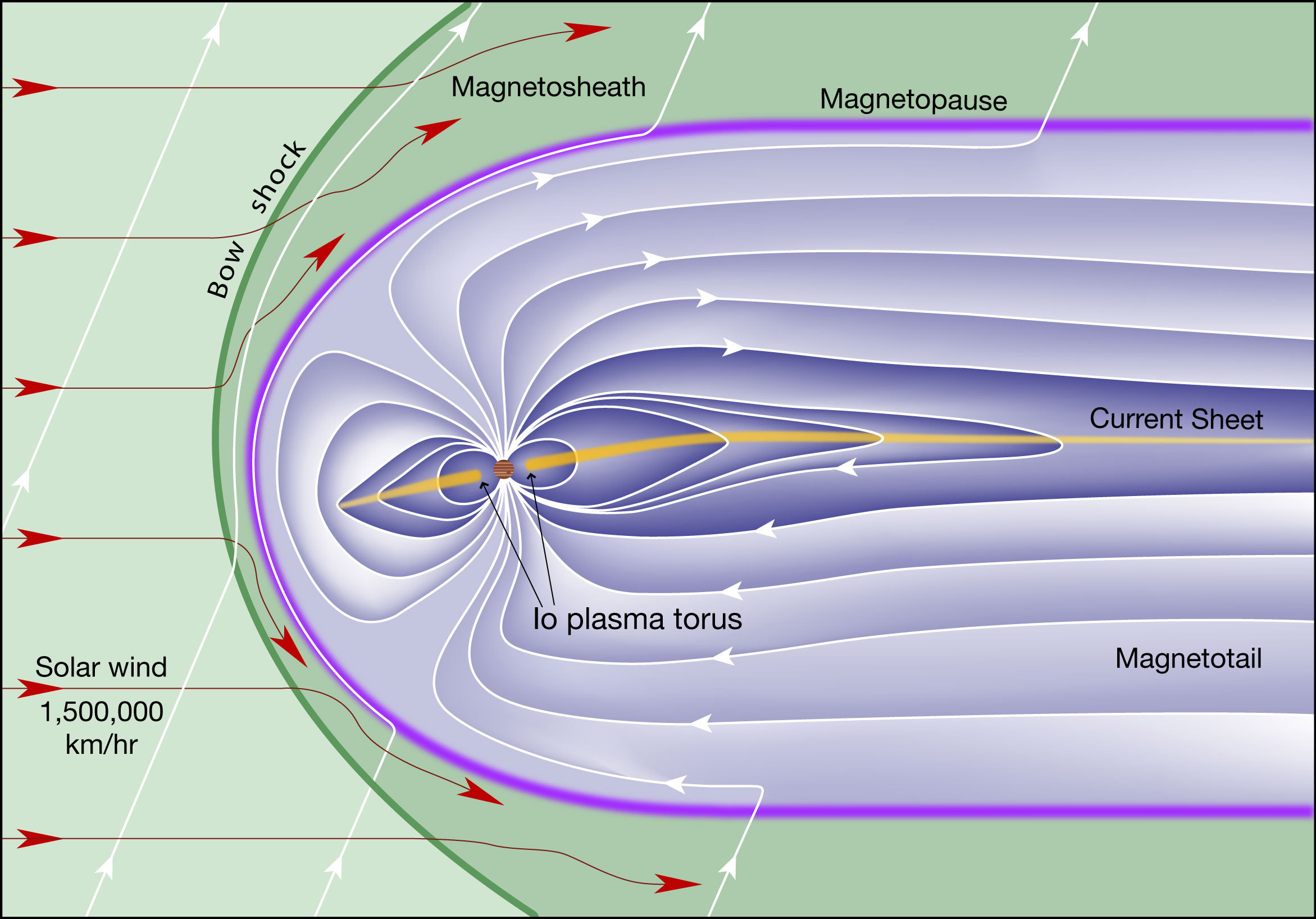
A planetary magnetosphere is the region where the planetary magnetic field dominates over the solar wind. This region is defined at the boundary of where the solar wind pressure is balanced with the planetary magnetic field and internal plasma pressure.
Jupiter's Magnetosphere. [Credit: Fran Bagenal & Steve Bartlett]
Why Study Magnetospheres?
The past 30 years of exploration have revealed that
planetary atmospheres, exospheres, and
magnetospheres (i.e., the planetary “space
environment”) are an integral component of planetary
systems, and also that magnetic fields and charged
particles have played significant roles in the origin
and evolution of the solar system.
Particle detectors were originally added to the
Pioneer 10 and 11 spacecrafts to measure the radiation
environment to be encountered by these and
subsequent spacecraft sent to image and traverse the
Jovian system. As we began to explore the giant
magnetosphere of Jupiter, it soon became clear that
the space environment of the planet had an importance
beyond the health of a spacecraft. It was quickly
realized that the strong magnetic field of Jupiter links
the planet to its moons and rings, and taps the rotation
energy of the planet, accelerating charged particles,
which then deposit their energy into the atmosphere of
the planet, exciting intense aurora, or bombard the
surfaces of satellites and rings.
Below are some examples of the importance of
understanding the space environment of solar system objects:
1. Planetary magnetic fields tell us about internal structure.
Six planets and at least one moon are
known to have internally generated magnetic fields.
The factors controlling why some objects have
magnetic fields and others do not put important
constraints on the composition and thermal history of
planetary interiors.
2. Plasma wind erodes atmospheres.
Planetary atmospheres that are embedded in a flowing plasma
are heated and eroded by the interaction. This
removal of material has a significant impact on the
composition and isotopic fractionation over
evolutionary timescales (e.g., solar wind removal of
atomic oxygen from Venus and Mars, ion tails of
comets and probably Pluto, loss of atmospheric
sodium and potassium from Mercury in substorms,
magnetospheric interactions with the atmospheres of Io, Titan, Europa).
3. Electrodynamic interactions reveal critical properties.
The electrodynamic interaction of a
plasma with a solid object reveals bulk properties of
its interior such as electrical conductivity and
magnetization, which in turn, place important
constraints on their composition and thermal history
(e.g., electrical conductivity of the Galilean
satellites, magnetization of Gaspra and Ida). Most
specifically, the induction signature detected by the
Galileo magnetometer is the only concrete evidence
of a global liquid ocean at Europa.
4. Comparison tests understanding.
The space environment of the magnetized planets is dominated
by the planet’s magnetic field. There are many
processes that these magnetospheres share in
common, processes that control their large-scale
structures, plasma sources, particle acceleration, and
transport mechanisms, and there are important
differences due to their disparate sizes, the
characters of their moons, the distance from the Sun
and the presence or absence of a thick atmosphere.
Comparison of the wide range of magnetospheres,
from the small magnetospheres of Mercury and
Ganymede to the giant magnetospheres of the Jovian
planets, allows us to understand these processes. Such
results will have further interdisciplinary usefulness in
interpreting extrasolar system astronomical objects.
5. Auroral bombardment heats atmospheres.
The energy deposited in the auroral regions of the
magnetized planets has dramatic atmospheric effects.
For Earth, we know that the local changes in
temperature, composition, and electrical properties of
the upper atmosphere produced by auroral
precipitation drive large-scale winds that affect the
upper atmosphere. Similarly, changes and motion in
the atmosphere are physically coupled back to the
magnetosphere via electric fields generated by these
winds and through the generation of energetic plasma
scattered or accelerated back into the magnetosphere.
Such coupling processes are probably commonplace
and even stronger for the giant planets than for Earth,
perhaps even dominating over the effects of solar
radiation at times.
6. Radiation modifies planetary surfaces.
When ices and rocks are bombarded by energetic particles,
the molecular structures can be rearranged, chemical
bonds changed, and material sputtered from the
surface. Thus, surfaces of planetary materials have
been altered over the history of the solar system by the
radiation environment in which they are embedded.
Such processes affect their spectral properties and
even change the surface composition, perhaps
playing an important role in prebiotic chemistry,
generating organic materials on the surfaces of dust
grains in the early solar nebula.
7. Magnetic fields shield planets from energetic
particles and cosmic rays.
Planetary magnetic fields deflect energetic particles originating from the
Sun and the galaxy and reduce the particle fluxes
hitting the planetary surface. Thus, the existence
and variability of planetary magnetic fields can play
an important role in accommodating or frustrating
the development of life on planets.
8. Electrodynamic forces transport dust.
Dust grains become electrically charged when embedded
in a plasma. Electrodynamic forces on charged dust
grains compete with gravity for control of the
dynamics of dust grains. Recent studies of dusty
plasmas show that these forces may be a critical
consideration for understanding the role and
behavior of dust in the solar nebula as well as in the
current solar system.
9. Planetary magnetospheres are laboratories.
Each planet provides a different a natural laboratory
for the study of plasma interactions and
electrodynamic phenomena. For example, the
interaction of the satellite Io with Jupiter’s
magnetosphere, which generates a million
megawatts of power, strips about a ton of sulfur and
oxygen atoms per second from Io’s atmosphere,
drives powerful electron beams, and triggers intense
radio and ultraviolet emissions.